
Nation commemorates 'godfather of technology'
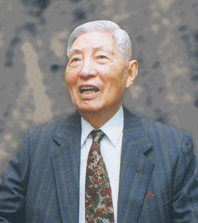
Li's friends, former colleagues and admirers gathered Jan. 13 in Taipei to celebrate the 100th anniversary of his birth and pay tribute to the "godfather of Taiwan's technology." Li was given the nickname since he was the chief architect of Hsinchu Science Park, the island's "Silicon Valley."
"If it were not for Li, there would be no Statute for the Encouragement of Investment or the Taiwan miracle, let alone the country's high-tech business," said former Finance Minister Lu Run-kang, who worked under Li for over 40 years. The statute helped Taiwan attract foreign investment and laid the foundation for the exponential growth of the island's manufacturing sector.
Born to a merchant family in Nanjing on the mainland, Li started to show his exceptional mind at an early age. After graduating in 1930 from the city's National Central University, where he majored in physics, Li taught for three years before he was awarded a scholarship and headed for Great Britain in 1934.
Li was admitted to the Emmanuel College of Cambridge University and joined the Cavendish Laboratory to study radioactive substances under the direction of Nobel laureate Ernest Rutherford (1871-1937). He later joined the university's Mond Laboratory to become the first Chinese scientist to study superconductivity. The training Li received during his years at Cambridge had a far-reaching influence on him, as he learned to tackle problems from a broad point of view, a rare quality that would allow him later to deal successfully with issues that faced war-stricken Taiwan.
The second Sino-Japanese War (1937-1945) put an end to Li's promising career as an experimental physicist. A patriot at heart, he believed he should give up his intellectual pursuit and use science to save his beloved country. "The war had a profound impact on my life, but I never regretted giving up my academic research," Li said during an interview in the late 1990s.
He returned to the mainland in 1938 to serve as a technician at the Air Defense School. Li then held different industrial jobs, first at a state-run steel-making mill on the mainland, then at a shipbuilding company in Taiwan from 1948. During this period, Li gained extensive management experience and a deep understanding of the industrial environment. His brilliant performance caught the attention of K. Y. Yin (Yin Zhong-rong, 1903-1963), who recruited Li in 1953 to serve on the Industrial Development Commission of the Republic of China.
Yin, who was the convener of the Economic Stability Board under the Executive Yuan, is praised today as the architect of Taiwan's economy. He was a strong believer of "planned market economy" and the guiding hand behind the nation's macro-economic planning during the 1950s. Yin also steered the country toward "import-substitution industrialization" in order to reduce the nation's foreign dependency, a move that later helped Taiwan transform from an agrarian society into an industrial nation.
As Yin's right-hand man, Li was not only a disciple of his economic philosophy, but also the principal executor of his policies. In 1958, Li followed Yin to become the secretary-general of the Council for U.S. Aid, the most important agency responsible for the country's economic policy and planning during the post-war period. The US$100 million in financial aid the United States provided every year was crucial in stabilizing and sustaining Taiwan's economy from 1951 to 1965.
During his tenure at the council, Li devised and implemented the Statute for the Encouragement of Investment, undoubtedly one of the most critical legislations in the nation's history and one of Li's many achievements. Approved by the Legislative Yuan and enacted in 1966, the statute facilitated the acquisition of land for industrial use and provided tax incentives to encourage savings, investments and exports, resulting in the rapid development of the nation's manufacturing sector. The statute expired in 1990 and was replaced by the Act for Upgrading Industries which still plays a significant role in the country's export-oriented economy.
Li was the first in 1956 to come up with the idea of an export processing zone, another of his innovations. However, since the project required coordination among several ministries, Taiwan had to wait 10 years before its first EPZ began operations in the southern port of Kaohsiung. This great pioneering vision proved to be instrumental in Taiwan's economic growth over the following decades, and inspired several other developing countries to establish their own EPZ models.
Implementing such economic zones not only attracted foreign investment, but also brought advanced manufacturing technologies. Taiwan's exports took off, creating jobs for the excess supply of farm labor and helping the island build up foreign reserves that fueled its future economic progress.
Li was appointed economic minister in 1965 and financial minister four years later, demonstrating his great vision in both positions. He began straightening up state-owned businesses and orchestrated a comprehensive tax reform program to enhance the efficiency of the country's tax administration and crack down on tax evasion.
"The structure of the tax system was altered completely. This is one of Li's greatest achievements as financial minister," said W.S. King, the director-general of the Taxation Agency under the MOF from 1969 to 1989.
Thanks to the new system, the government was able to significantly increase its tax revenues, providing the necessary funding for the Ten Major Construction Projects that modernized the island's infrastructure in the 1970s. The projects included building key utilities such as a north-south highway, an international airport, power plants and an industrial park.
Li retired from his post as financial minister in 1976 because of health problems. He was appointed minister without portfolio the same year and put in charge of directing efforts among ministries, councils and agencies to accelerate the country's technological development.
Li called the first National Convention for the Development of Science and Technology in 1978, where experts and scholars from domestic and overseas institutions, business leaders, and government officials convened to discuss the future direction of Taiwan's high-tech development. Based on the convention's conclusions, energy, industrial materials, information and automation were selected as the four strategic industries of the island.
Just as former Premier Sun Yun-suan (1913-2006) is known as the father of the Industrial Technology and Research Institute, Li is often called the godfather of Taiwan's technology because he was the mastermind behind the Hsinchu Science Park. Both ITRI and the science park were the driving forces that propelled the country forward to emerge as a global technological powerhouse.
Inspired by the success of Silicon Valley in the United States, Li envisioned in the late 1970s a business model similar to an EPZ for Taiwan's flourishing electronics industries. He consulted Frederick Terman (1900-1982), the legendary founder of Silicon Valley, on how Taiwan could duplicate the valley's success.
Following Terman's advice, Li managed to convince local talent who had moved abroad to come back to work in Taiwan. Morris Chang, chairman of Taiwan Semiconductor Manufacturing Co., was among those who agreed to return. "If it were not for Minister Li, there would be no TSMC," he said. Chang was recruited to head ITRI in 1986 and then commissioned by Li in 1987 to found TSMC, the world's largest semiconductor foundry.
To attract funds to finance the burgeoning startups in the science park, Li introduced the concept of venture capital to the country, another of his foresights that later proved crucial to the Hsinchu Science Park's success.
In 1979, before the advent of information technology, the visionary Li led the country's public and private sectors to establish, in cooperation with the academic community, the Institute for Information Industry, a non-governmental organization dedicated to promoting Taiwan's information industry.
Frederick Seitz (1911-2008), a renowned U.S. physicist and a member of the Science and Technology Advisory Group under the Executive Yuan during the 1980s, compared Li's standing to "that of individuals such as John Adams, Benjamin Franklin, Alexander Hamilton, and James Madison somewhat rolled into one person." Bob Evans (1927-2004), another STAG advisor during the same period, wrote that "those that were fortunate enough to know [Li] personally will be inspired all their lives by this wonderful man, truly one of the great people of this world."
Perhaps Li's contribution to his country can best be summarized by his own words. When answering a question in 1999 by Premier Liu Chao-shiuan, who was the vice premier at the time, Li said that the most important thing he had done for Taiwan was to "improve the country's investment environment." "So long as this is done right, everything else will fall into place. As the investment environment improves, talent will flock to the island and capital will follow," Li added.
On his 90th birthday, Li summed up his life by saying he had not lived in vain after all. For a man who helped shape Taiwan's economic landscape over half a century, this is clearly an understatement.

No comments:
Post a Comment